InjectTool Databases
Cryoweb helper database
The cryoweb database is modeled started from an empty cryoweb instance. It models
the minimal permission and table definitions in order to make possible to upload
cryoweb data from a postrges data only dump file. This database is filled by
cryoweb module, using cryoweb.tasks.ImportCryowebTask.import_data_from_file().
After import is done (with success or not), database is cleaned and restored to
the original state.
The Unified Internal Database
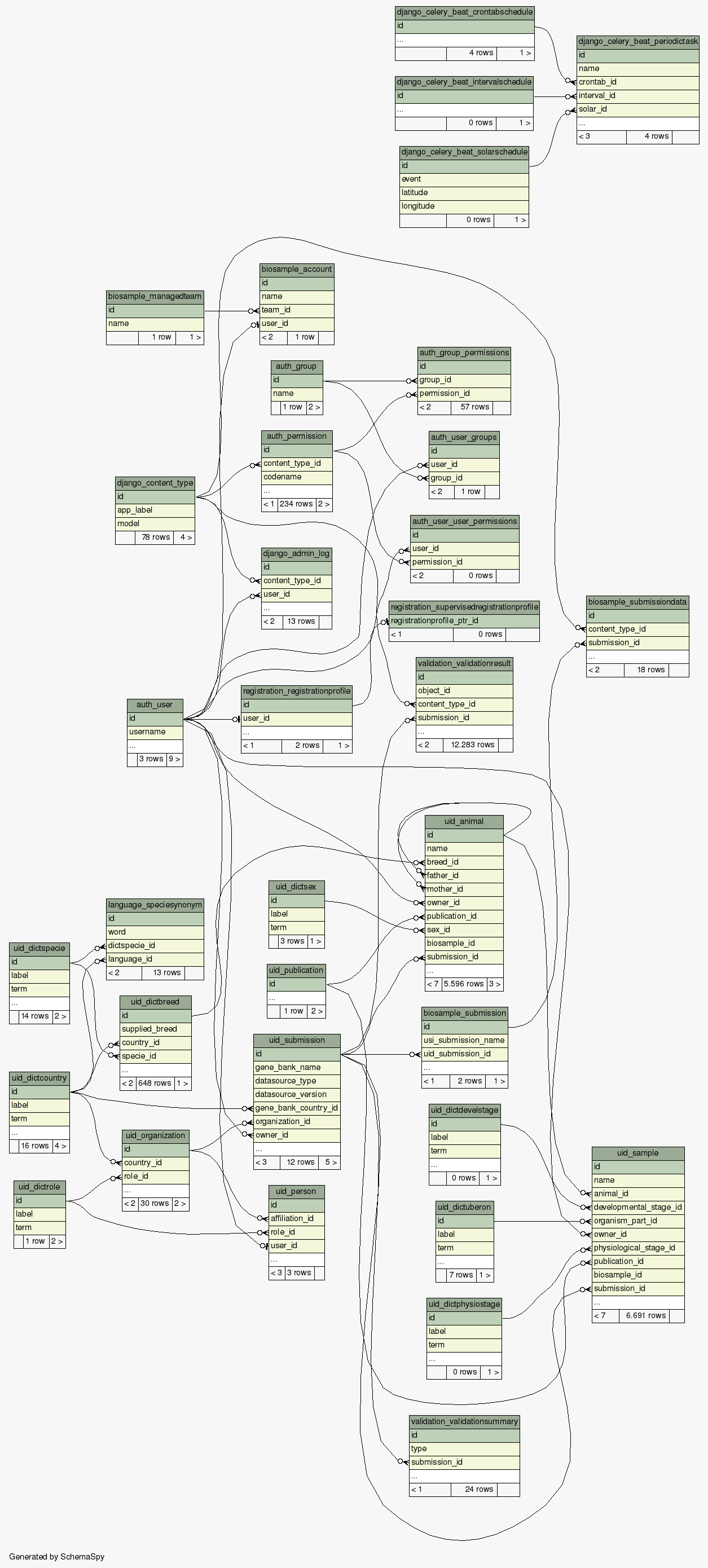
The Unified Internal Database (UID) is the database in which all IMAGE-InjectTool
data are stored. It is mainly managed by uid.models package, and
models dictionary tables, which are used to provides ontologies references, and
data tables, which are used to store user data like Animals (Organisms) and Samples
(Specimens from Organim). Data tables are linked to user (owner) in order to
be private for user who owns such data, while dictionary
tables are common for all user in order to facilitate ontology update and resolve
the same terms with the same ontology.
Near the UID tables, there are also biosample.models tables, which keep
the relationship between InjectTool users and EBI AAP users; They keep also track
of data that are currently in submission state, waiting for a stable BioSamples id.
validation.models tables keeps information about data validation performed
against IMAGE-metadata rules through IMAGE-ValidationTool package and
language.models models tables related to language specific term (like species names)
Here is an example picture of UID relationships:
The Redis Database
This database acts as a temporary space required to celery.app.task.Task.
and its derived classes defined in InjectTool modules tasks.py packages. It
stores also the user generated token after a user start a submission using
biosample.views.SubmitView