Asynchronous Tasks
Configuring celery environment
Celery is instantiated for all InjectTool in image.celery module. Briefly,
here celery is started and all defined task need to be readed while defining
environment:
import os

from celery import Celery
from celery.utils.log import get_task_logger

logger = get_task_logger(__name__)

# reading configuration from django
os.environ.setdefault('DJANGO_SETTINGS_MODULE', 'image.settings')

# starting celery app
app = Celery('proj')

# search for tasks inside imported modules
app.autodiscover_tasks()
More info with celery and django could be found in First steps with Django documentation
Defining Tasks
There are two distinct ways of defining celery tasks. The first is by defining
a method and then decorate it with the celery.Celery.task() method:
@app.task(bind=True, base=app.Task)
def clearsessions(self):
    """Cleanup expired sessions by using Django management command."""

    logger.info("Clearing session with celery...")

    # debugging instance
    self.debug_task()

    # calling management command
    management.call_command("clearsessions", verbosity=1)

    # debug
    logger.info("Sessions cleaned!")

    return "Session cleaned with success"
The main advantage of such task is that they are discovered and instantiated in celery workers automatically using:
app.autodiscover_tasks()
However, could be difficult to implement complex operations inside a single function.
For such reason, the suggested way to implementing tasks is to define tasks as
classes, derived from celery.app.task.Task:
class FetchStatusTask(app.Task):
    name = "Fetch USI status"
    description = """Fetch biosample using USI API"""

    def run(self):
        """This function is called when delay is called"""

        # do stuff
You need to declare class based task inside celery environment, otherwise you will not be able to call a task:
# register explicitly tasks
# https://github.com/celery/celery/issues/3744#issuecomment-271366923
app.tasks.register(FetchStatusTask)
Exclusive Tasks
In order to execute mutually exclusive task, you need to decorate the run function like this:
from common.tasks import BaseTask, NotifyAdminTaskMixin, exclusive_task

class FetchStatusTask(NotifyAdminTaskMixin, BaseTask):
    name = "Fetch USI status"
    description = """Fetch biosample using USI API"""

    @exclusive_task(task_name="Fetch USI status", lock_id="FetchStatusTask")
    def run(self):

        """This function is called when delay is called"""

        # do stuff
task_name and lock_id parameters are required for logging and to define
a lock into REDIS database in order to ensure that this task will be executed
once in the same time (other task will success with already running message)
Calling Tasks
Each task type (decorated function or class based) has a run method in which
stuff will be executed. By decordating a task, a class object will be instantiated and
the user defined function is called through run method. For class based tasks,
you have to define the run method manually. Calling run method, will execute
stuff synchronously, in the same environment were the function is called. The
execution of operation will be blocked until the run method returns an output.
Calling task with delay method, will call stuff asynchronously, releasing the caller
immediately and returning an celery.result.AsyncResult object:
# will wait until a result is returned by run method
clearsessions.run()

# call asynchronous task. Get result object immediately
result = clearsessions.delay()

# check task finished:
if result.ready() is True:
    print(result.info)
Routine Tasks
Routine tasks are called regularly according to crontabs defined in InjectTool
database. They derive from celery.app.task.Task as any other task,
but they require additional configuration in order to be called regularly. This
configuration can be added in django.conf.settings as follow:
from celery.schedules import crontab

# Other Celery settings
CELERY_BEAT_SCHEDULE = {
  'clearsessions': {
      'task': 'image.celery.clearsessions',
      'schedule': crontab(hour=12, minute=0),
  },
  'fetch_biosample_status': {
      'task': "Fetch USI status",
      'schedule': crontab(hour="*", minute='*/15'),
  }
}
celery.schedules.crontab is the object required to define regular time
intervals. Defining regular tasks in image.settins let to generate records in
database using django-celery-beat django package. You could also define periodic
task using django.contrib.admin
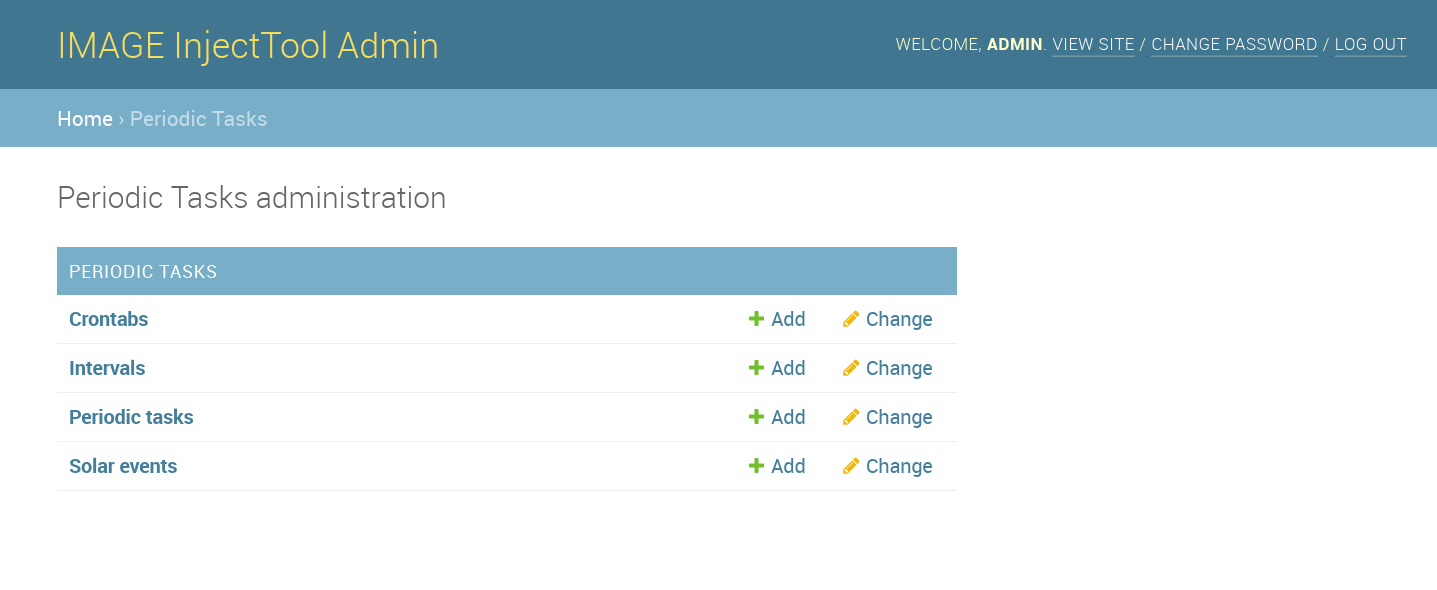
However defining periodic task in settings let to create django-celery-beat database records, if such tasks are not present in the database when InjectTool is started